CAPITAL STRUCTURE AND FIRM PERFORMANCE IN DIFFERENT ECONOMIC CONDITION
DOI:
https://doi.org/10.36690/2674-5208-2025-3-36-47Keywords:
capital structure, firm performance, agency theory, economic growth, CSR disclosure, emerging markets, IndiaAbstract
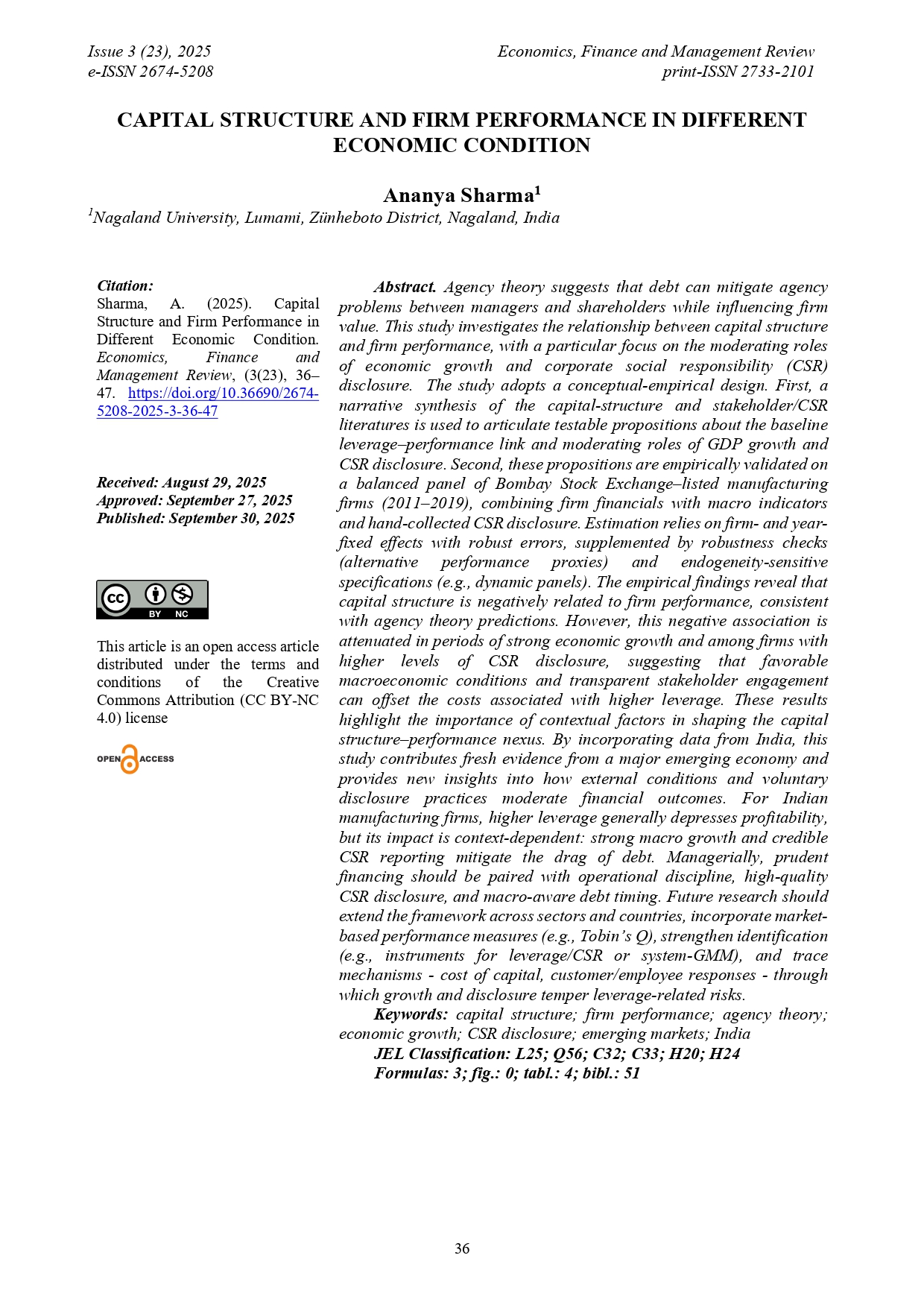
Agency theory suggests that debt can mitigate agency problems between managers and shareholders while influencing firm value. This study investigates the relationship between capital structure and firm performance, with a particular focus on the moderating roles of economic growth and corporate social responsibility (CSR) disclosure. The study adopts a conceptual-empirical design. First, a narrative synthesis of the capital-structure and stakeholder/CSR literatures is used to articulate testable propositions about the baseline leverage–performance link and moderating roles of GDP growth and CSR disclosure. Second, these propositions are empirically validated on a balanced panel of Bombay Stock Exchange–listed manufacturing firms (2011–2019), combining firm financials with macro indicators and hand-collected CSR disclosure. Estimation relies on firm- and year-fixed effects with robust errors, supplemented by robustness checks (alternative performance proxies) and endogeneity-sensitive specifications (e.g., dynamic panels). The empirical findings reveal that capital structure is negatively related to firm performance, consistent with agency theory predictions. However, this negative association is attenuated in periods of strong economic growth and among firms with higher levels of CSR disclosure, suggesting that favorable macroeconomic conditions and transparent stakeholder engagement can offset the costs associated with higher leverage. These results highlight the importance of contextual factors in shaping the capital structure–performance nexus. By incorporating data from India, this study contributes fresh evidence from a major emerging economy and provides new insights into how external conditions and voluntary disclosure practices moderate financial outcomes. For Indian manufacturing firms, higher leverage generally depresses profitability, but its impact is context-dependent: strong macro growth and credible CSR reporting mitigate the drag of debt. Managerially, prudent financing should be paired with operational discipline, high-quality CSR disclosure, and macro-aware debt timing. Future research should extend the framework across sectors and countries, incorporate market-based performance measures (e.g., Tobin’s Q), strengthen identification (e.g., instruments for leverage/CSR or system-GMM), and trace mechanisms - cost of capital, customer/employee responses - through which growth and disclosure temper leverage-related risks.
Downloads
References
Abdullah, Y., Ahmad-Zaluki, N. A., & Rahim, N. A. (2021). Determinants of CSRD in non-Asian and Asian countries: A literature review. Journal of Global Responsibility, 12(1), 114-114.
Abeysekera, I. (2010). The influence of board size on intellectual capital disclosure by Kenyan listed firms. Journal of intellectual capital, 11(4), 504-518.
Adams, R. B., & Ferreira, D. (2007). A theory of friendly boards. The Journal of Finance, 62(1), 217-250.
Adefolake, A. O., & Omodero, C. O. (2022). Tax Revenue And Economic Growth In Nigeria. Cogent Business & Management, 9(1), 2115282.
Alfaro, L., Chanda, A., Kalemli-Ozcan, S., & Sayek, S. (2004). FDI and economic growth: the role of local financial markets. Journal of international economics, 64(1), 89-112.
Ali, W., Gohar, R., Chang, B. H., & Wong, W.-K. (2022). Revisiting the impacts of globalization, renewable energy consumption, and economic growth on environmental quality in South Asia. Advances in Decision Sciences, 26(3), 1-23.
Almustafa, H., Nguyen, Q. K., Liu, J., & Dang, V. C. (2023). The impact of COVID-19 on firm risk and performance in MENA countries: Does national governance quality matter? PloS one, 18(2), e0281148.
Alshehry, A. S., & Belloumi, M. (2015). Energy consumption, carbon dioxide emissions and economic growth: The case of Saudi Arabia. Renewable and Sustainable Energy Reviews, 41, 237-247.
Altunbas, Y., Carbo, S., Gardener, E. P., & Molyneux, P. (2007). Examining the relationships between capital, risk and efficiency in European banking. European Financial Management, 13(1), 49-70.
Ararat, M., & Yurtoglu, B. B. (2020). Female directors, board committees, and firm performance: Time-series evidence from Turkey. Emerging Markets Review, 100768.
Awdeh, A., & El-Moussawi, C. (2022). Capital requirements, institutional quality and credit crunch in the MENA region. International Journal of Emerging Markets, 17(8), 1909-1925.
Azman-Saini, W. N. W., & Law, S. H. (2010). FDI and economic growth: New evidence on the role of financial markets. Economics Letters, 107(2), 211-213.
Cai, J., Liu, Y., Qian, Y., & Yu, M. (2015). Information asymmetry and corporate governance. Quarterly Journal of Finance, 5(03), 1550014.
Dang, V. C., & Nguyen, Q. K. (2021). Internal corporate governance and stock price crash risk: evidence from Vietnam. Journal of Sustainable Finance & Investment, 1-18. doi:10.1080/20430795.2021.2006128
Dang, V. C., Nguyen, Q. K., & Tran, X. H. (2022). Corruption, institutional quality and shadow economy in Asian countries. Applied Economics Letters, 1-6.
Danisch, C. (2021). The relationship of CSR performance and voluntary CSR disclosure extent in the German DAX indices. Sustainability, 13(9), 4904.
DeAngelo, H., DeAngelo, L., & Whited, T. M. (2011). Capital structure dynamics and transitory debt. Journal of financial economics, 99(2), 235-261.
Fama, E. F. (1980). Agency problems and the theory of the firm. Journal of political economy, 88(2), 288-307.
Fama, E. F., & Jensen, M. C. (1983). Agency problems and residual claims. The journal of law and Economics, 26(2), 327-349.
Galbreath, J. (2018). Is board gender diversity linked to financial performance? The mediating mechanism of CSR. Business & Society, 57(5), 863-889.
Ha, L. T., Dung, H. P., Chuong, P. H., Thanh, T. T., & Huong, T. T. L. (2021). Global economic sanctions, global bank linkages and information asymmetry: an evidence from cross-country data. Global Economy Journal, 21(03), 2150011.
Harris, C., & Roark, S. (2019). Cash flow risk and capital structure decisions. Finance Research Letters, 29, 393-397.
Jain, A., Keneley, M., & Thomson, D. (2015). Voluntary CSR disclosure works! Evidence from Asia-Pacific banks. Social Responsibility Journal, 11(1), 2-18.
Jensen, M. C. (1986). Agency costs of free cash flow, corporate finance, and takeovers. The American economic review, 76(2), 323-329.
Jensen, M. C., & Meckling, W. H. (1976). Theory of the firm: Managerial behavior, agency costs and ownership structure. Journal of financial economics, 3(4), 305-360.
Kim, J. H., Lee, S. H., & Keun Yoo, Y. (2020). Real earnings management and the cost of debt capital: international evidence. Asia-Pacific Journal of Accounting & Economics, 27(2), 151-172.
Margaritis, D., & Psillaki, M. (2010). Capital structure, equity ownership and firm performance. Journal of Banking & Finance, 34(3), 621-632.
Modigliani, F., & Miller, M. H. (1958). The cost of capital, corporation finance and the theory of investment. The American economic review, 48(3), 261-297.
Myers, S. C. (1984). Capital structure puzzle: National Bureau of economic research Cambridge, Mass., USA.
Nguyen, K. Q., Phan, H. T. M., & Pham, N. N. T. (2026). An inverted u-shaped relationship between carbon dioxide emissions and economic growth: The role of institutional quality in developing countries. HO CHI MINH CITY OPEN UNIVERSITY JOURNAL OF SCIENCE-ECONOMICS AND BUSINESS ADMINISTRATION, 16(1).
Nguyen, Q. K. (2022a). Audit committee structure, institutional quality, and bank stability: evidence from ASEAN countries. Finance Research Letters, 46, 102369.
Nguyen, Q. K. (2022b). Determinants of bank risk governance structure: A cross-country analysis. Research in International Business and Finance, 60, 101575. doi:https://doi.org/10.1016/j.ribaf.2021.101575
Nguyen, Q. K. (2023). Does the financial flexibility prevent stock price crash risk during COVID-19 crisis? Evidence from the Vietnamese stock market. Heliyon, 9(11).
Nguyen, Q. K. (2024a). The Development of the Life Insurance Market and Bank Stability in Developing Countries. Heliyon.
Nguyen, Q. K. (2024b). Globalization, credit information sharing and financial stability in developing countries. Economic Change and Restructuring, 57(6), 1-21.
Nguyen, Q. K. (2025a). Cross‐Ownership and Bank Stability: The Moderating Role of Corporate Social Responsibility Disclosure. Corporate Social Responsibility and Environmental Management.
Nguyen, Q. K. (2025b). Green Finance, Climate Risk and Financial Stability: Evidence from ASEAN+ 4 Countries. Environmental and Sustainability Indicators, 100922.
Nguyen, Q. K., & Dang, V. C. (2023). The impact of FinTech development on stock price crash risk and the role of corporate social responsibility: Evidence from Vietnam. Business Strategy & Development.
Nguyen, Q. K., Nguyen, T. V. H., & Tran, D. L. (2025). The relationship between financial flexibility strategy and firm performance and the role of corporate governance: evidence from Southeast Asia. Macroeconomics and Finance in Emerging Market Economies, 1-21.
Nguyen, Q. K., Tran, D. L., Tran, X. H., Pham, N. T. N., & Nguyen, N. P. L. (2025). The complex relationship between carbon dioxide emissions, foreign direct investment, and economic growth in Asian countries. Discover Sustainability, 6(1), 831.
Ocal, O., & Aslan, A. (2013). Renewable energy consumption–economic growth nexus in Turkey. Renewable and Sustainable Energy Reviews, 28, 494-499.
Ronoowah, R. K., & Seetanah, B. (2024). Capital structure and the firm performance nexus: The moderating and mediating roles of agency cost. Managerial Finance, 50(9), 1598-1621.
Semenescu, A., & Curmei, C. V. (2015). Using CSR to mitigate information asymmetry in the banking sector. Management & Marketing, 10(4), 316-329.
Sharma, R., Kautish, P., & Kumar, D. S. (2018). Impact of selected macroeconomic determinants on economic growth in India: An empirical study. Vision, 22(4), 405-415.
Soedarmono, W., Machrouh, F., & Tarazi, A. (2011). Bank market power, economic growth and financial stability: Evidence from Asian banks. Journal of Asian Economics, 22(6), 460-470.
Tran, D. L., & Nguyen, Q. K. (2025). The moderating effect of monetary policy and ESG practices on the relationship between leverage and firm value in ASEAN-5 emerging countries. Applied Economics, 1-16.
Tran, D. L., Pham, D. T., & Nguyen, Q. K. (2025). The Relationship Between Credit Supply, Capital Structure and Firm Performance of Listed Real Estate Firms: Evidence from an Emerging Country. Sage Open, 15(2), 21582440251339290.
Uddin, M. N., Rashid, M. H. U., & Rahman, M. T. (2022). Profitability, marketability, and CSR disclosure efficiency of the banking industry in Bangladesh. Heliyon, 8(11).
Vishwanathan, P., van Oosterhout, H., Heugens, P. P., Duran, P., & Van Essen, M. (2020). Strategic CSR: A concept building meta‐analysis. Journal of Management Studies, 57(2), 314-350.
Yang, P., Riepe, J., Moser, K., Pull, K., & Terjesen, S. (2019). Women directors, firm performance, and firm risk: A causal perspective. The Leadership Quarterly, 30(5), 101297.
Zeitun, R., & Goaied, M. (2022). The nexus between debt structure, firm performance, and the financial crisis: non-linear panel data evidence from Japan. Applied Economics, 54(40), 4681-4699.
Downloads
Published
How to Cite
Issue
Section
License

This work is licensed under a Creative Commons Attribution-NonCommercial 4.0 International License.